Showing posts with label YA. Show all posts

Tuesday, December 30, 2014

Review: The Summer Prince by Alaya Dawn Johnson

“They think they’ve gone to heaven,” he says. “They don’t realize that means they’re dead.”

Matriarchy. Class. Monarchy. Those words evoke a lot of feelings for people, whether these factors influence them or not. And why shouldn’t they bring out these emotions? One of them defies the “norm”, another is a daily reality, and the final is a form of government many people aggressively protest. Yet all three come together in a beautiful dystopian novel, so beautiful because by my definition, it is not a dystopia at all. It’s a telling tale of politics and changed times and what happens when the system is warped. And among it all are an artist, a lovesick boy, and a king – a king meant to die.

Today, we’re looking at The Summer Prince by Alaya Dawn Johnson.

***

These days, it seems like all of my good books come from Diversity in YA, and this is no exception. I put it on my wish list for my birthday and got it – but it was only on the sixteenth of this month that I finally finished it, approximately 30,000 feet above ground.

I mean, I was in a plane. But regardless.

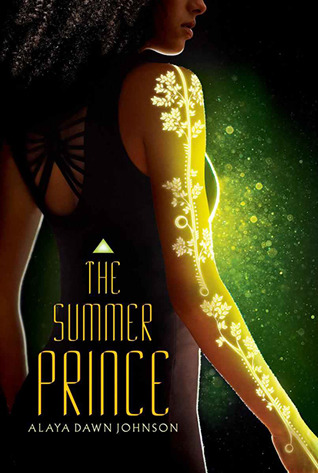
I think what drew me to this book was the cover. They say never to judge a book by its cover, but I’ll admit, I do it all the time – which is WHY a good book cover is incredibly important if you’re trying to sell a book. The Fault in our Stars has an iconic cover. The Song of the Lioness series has beautiful illustrations. And Grasshopper Jungle is – well, Grasshopper Jungle. You know what I mean.

I do not know who designed the book cover, but I do know the intentions behind it, which you'd have to find out by reading the book. But it’s a grasping cover, one that makes you want to ask questions. Who is this girl? What are the lights that seem to come from within her skin? And by all means, who IS the Summer Prince?

Let me just say this: a cover that makes you ask, and a book that gifts you answers, is ALWAYS an A-plus combo.

***

Sometimes a narrative’s voice isn’t really noticeable . . . and sometimes, that’s okay. The voice is a 1st person point of view from the perspective of June Costa, a waka living on the eighth tier of the pyramid city of Palmares Três. Due to her living on the eighth tier, she is considered somewhere between middle and upper class – most likely upper, due to her stepmother being an Auntie, or politician. And before you ask, her father is dead – her stepmother is married to her actual mother. Yay, LGBT representation!

Due to June’s position, both as an upper class person and a teenager, we get to see into a lot of thoughts in her head. Many of them have to do with her position above the other classes (particularly those classes who live on the verde, or poor area of the city), and on her opinions of others, like her fellow classmates. It’s a good view to have, because she is a person with a lot of things to think about and speak out about. After all, she is an artist, and most artists, I’ve found, have quite a bit to say.

Most YA books tend to have the same style, or at least as far as I’ve noticed. This is no exception; the character development is straightforward, the writing is clear, etcetera. Not much to say here except that I wish there was some more detail and clarification – I couldn’t follow along with some of the descriptions, especially when June was in the verde! I understand this is a tricky business because I have similar troubles myself, but it only becomes more evident with some of the maneuvers June has to do to get through the verde. More on this later, when I get to the spoilers.

***

June’s story begins with the selection of the Summer King in Palmares Três. Now, who is the Summer King, you ask? The Summer King is ritually selected to act as the queen’s “consort”, and he, after his term is over, will select the new queen. Now, this is normally pretty pointless, because the only person available in the room at the time of selection is, well, the queen.

“But T.J.!” I hear you saying. “Why can’t he just pick somebody outside the room? Can’t he just go and bring them in?”

Actually, no. He can’t – because his selection begins the moment his throat is slit. He has that time, until he dies, to select the next queen. Because that’s the thing about Summer Kings – they are picked to die at the end of term.

Now, why does this matter so much? Well, the new Summer King is named Enki, a boy from the verde, and June figures out very quickly that he is an artist. His art? I have no room to reveal that yet, but let’s just say that when June realizes this, she quickly works to make him her collaborator. After all, she has a bit of an award to win, and it’s not like she’s inconveniencing him – after all, he’s already made her best friend his own lover . . .

Not enough detail? No, too much, really. If you are still confused, you will find just about as much information on the back of the book as you will find in this review. Just believe me – the plot is a WHIRLWIND, and I love its progression. Believe me, it’s worth every penny.

***

Time for SPOILERS! If you don’t want to be spoiled, DON’T READ THIS NEXT PART! Skip to the end and you’ll know my verdict.

***

***

This isn't a typical dystopian/utopian novel – most dystopias become overturned, with the government/society being torn down and built anew. That does not happen in this book; in fact, the focus is not about overthrowing the government, but exposing its corruption, and later attempting to escape it. The end result is the repair and, one can only assume, the reparation of what went wrong – but I can’t go into that, even in the spoilers section.

***

I mentioned earlier that there was some LGBT content? I wasn’t kidding. There are TWO clear-cut LGBT couples in the book – June’s parents, and the Summer Prince’s relationship with June’s best friend, Gil. The book also demonstrates diversity in the obvious way, being that these are Brazilian persons with dark skin, even to the point where the Summer Prince, Enki, calls himself a negro for his deep, dark skin. Add to that the language bit, and there’s diversity flying out everywhere. There’s even a reference to when they attempt to sing in English!

I love diversity in books, no matter what it is. If you are looking for a YA diverse book – well, this is it!

***

Now, I’m going to go ahead and alert y’all to a potential trigger, because I know that I enjoy knowing about these sorts of things before I read books. About halfway through the book, you learn that before the events in the story, June’s father had taken his life – from what I could garner, and from what was described, he had fallen into depression and had filed for what my guess is euthanasia. Shortly after this, a character within the story takes his own life as well, although neither of the scenes are graphic, and neither character is young when this happens. The excuse is made that “oh, they were old, it was their time, technology makes us live too old anyways”, but then again, I don’t buy that bullshit. Take it as you will.

As for any other warnings, I would advise that there are two sexually explicit scenes, although the one isn’t so much “explicit” as much as it’s just obvious that somebody is doing the deed. I wouldn’t let these sway you, because it’s YA fiction anyways, but just in case you wanted to know. There are also two graphic deaths that take place, but neither of them are suicides, and the scene in which they die is rather short. The descriptions that come later are also graphic, but not to the same extent.

***

The one other thing that I can think of to mention is that I REALLY like that this was a matriarchy, and the problem wasn’t that it was a matriarchy – there was definitely some humanist arguments, but largely, the problem in and of itself was not that the rule was by women. Basically, you could’ve substituted a patriarchy in and the complaints would’ve been about the same.

I LOVE when writers do this. I love it when they go ahead and mess with the social order, and then show that by the way, it’s OKAY. It’s the same reason I read diverse books; it shows that it’s not the end of the world, and that it’s really not so different (i.e. bad) as people think it is.

***

***

Spoilers end here!

***

So how does the book do? Let’s return to the 10-point system.

Voice: 8/10. It’s nothing out of the ordinary, which is fine, but it also didn’t necessarily stand out to me. So it’s not bad, but there was room for improvement.

Style: 7/10. Still not seeing anything new, but it was still good, so thumbs up here. That being said though, points are lost with the lack of detail.

Plot: 10/10. This was really the high point of the book, that the plot was both predictable but also surprising to read. As I said, it’s not your average dystopia, and for that, I’m very grateful.

Readability: 9/10. It’s not a challenge, so it loses points, but either way, no problems here. Unless you’re going to throw a hissy fit over the occasional Portuguese, then I wouldn’t worry about it.

Average: 8.5/10. Seems fair enough to me, although I would maybe round that up to nine. After all, I took off points for the lack of challenge, which may just be a me thing.

So, would I recommend this book? A hundred percent I would! I adored this book, even though it took a little time for me, personally, to get through it (not because it’s long, but because university and finals are hard). It was a great spin on a typical story of its genre, but took the idea in a new direction by playing with core elements and eliminating the need for a total reconstruction at the end. Overall, if you need something to pass the time with on a couple of airline flights, The Summer Prince is one of the books I recommend a hundred percent!

Wednesday, July 2, 2014

Is it the Cursing, or the Sexuality?

I thought the sexuality thing was supposed to be getting easier. Instead, I feel like there's more that needs to be done than ever, although maybe that's more to do with my hyperawareness about the issue.

What am I going on about, you ask? This. Go ahead; read it. I think it's important that you do, because I really can't sum it up in my words - it's best explained in detail.

Done?

I can't say much about the issue right now, because I'm a little upset about it, but I did take advantage of the emails provided on the website in order to send an email to the school board. Of course, I talked about the sexuality thing. I agree with the writers of the article; it seems much more likely that the issue had to do with sexuality, not the cusses. Let's face it, most teenagers hear cusses every day from their family than they read in a single book.

Here's my real concern, though: as a school board, how can they discourage the reading of a book that would encourage and educate those that pick that same book up?

It seems to me that the school board has taken what is pretty clearly an issue book from their reading list for the reason, "It has a couple of swear words in it". Is that really all? Issue books can help readers identify and empathize with those who are deeply invested, personally, in those issues. It makes it easier to understand your best friend, or even yourself and your same-sex partner. Those issues, especially these days, are REALLY important in high school, where each year is another bumbling jog to figuring out who you are.

Why would you deny that to the people who need it most?

The other issue is that by taking the book off the list, they've merely ensured that people will read it. I mean, I'm considering RIGHT NOW looking up the book and reading it (because I may not have read it, but that doesn't mean I'm totally ignorant!). One of the things I've heard most often about banned books is that people are more likely to read banned books BECAUSE they are banned. Back in April, I was writing Project: Hope and filled out a survey about if it would be banned or not. Answer: Yes. Funnily enough, I was okay with that (it was banned for more than just sexuality. I do not write by the rules).

So, to summarize: I'm irked. I'm irked, and I'm irked because it both discourages the education and empathy towards LGBT* persons while also ensuring that everybody and their dog is about to pick up . . . which really means that the school board just shot itself in the metaphorical foot.

. . . I really hope the school board never gets their hands on this post, now, for saying that. But I want to be honest, and that's just what I think: taking it off the list was a bad idea, and it has a lot more potential for blowing up in their faces than just the scores of emails I'm sure they're getting.

Remind me never to work in education.

(BTW - I used lots of sources when I was talking to them. Check them out.)

ETA: I just remembered: in the link where I learned about this, I read about a couple of booksellers that were donating books to give to people to read, so that way this book could get around. INSTEAD, might I suggest buying a few copies? Let's support the writer, guys!

Sunday, June 29, 2014

Review: "Grasshopper Jungle" by Andrew Smith

"There are things in here: babies with two heads, insects as big as refrigerators, God, the devil, limbless warriors, rocket ships, sex, diving bells, theft, wars, monsters, internal combustion engines, love, cigarettes, joy, bomb shelters, pizza, and cruelty. Just like it's always been."

My feelings about this book are so mixed you could pour them in a pan, pop it in the oven, and pull out a fluffy cake half an hour later. You know what I mean.

Today, I'm reviewing Grasshopper Jungle by Andrew Smith.

***

First off, I want to complement the publishers (Penguin Group/Dutton) for dragging me in by the hair. I found this at my local bookstore and, upon seeing the cover and reading the blurb, was drawn in. I decided to grab the book after some contemplation, and along with another purchase and an extra book called-in, I had a stack of reading to go through. I started this one immediately.

I began Tuesday. I finished today (actually, technically yesterday - today is just two hours old). I read a part a day, skipping Thursday, and finished a few hours ago. I'm still working on digesting all of the story, but I'll do my best to discuss the contents, but I will discuss some spoiler-y stuff at the bottom. Don't worry; I have warnings posted.

***

One of the things that you can complement Smith for is his excellent mastery of voice. He tells the story from the perspective of Austin Szerba, a 16-year old Lutheran boy who has a knack for history and, oddly enough, arousal jokes. Yeah, not the first person you'd think of as a narrator, but a good choice for the novel. Besides, Austin's not the weirdest part of this story, not by a long shot.

Anyways, Smith's use of voice was excellent, exceptional even. The issue was that because of the nature and voice of the protagonist/narrator, things naturally started to get unhinged and hard to follow. While Austin enjoys history and the connections made in history and the present moment, he tends to ramble a lot. And I mean a lot. A lot of what he rambles about carries throughout the book, of course, but not all of it does, and it results in an awkward dance between the story and what's just going on in Austin's head. In addition, it also makes it harder to tell what is happening in the story; while it's not always difficult to piece together the events, there are certainly moments that left me head-scratching.

It was confusing, to say the least.

***

Now, as for the plot.

*intake of breath*

The plot is about how two boys accidentally let loose an army of hungry and horny praying mantises that put their Iowan town - and the world - in grave danger, leaving them the only two who can stop the stampede.

...

I'm seriously not kidding.

The moment I read the blurb, I laughed out loud. I mean, nobody publishes plots like those. That's the type of plots typically joked and laughed about, right? That's the type of plot a twelve-year old would come up with! Despite that - more like because of it - I was prepared to pick up the book and be dragged into a crazy ride.

I mean, it's fun, silly, and still incredibly contemplative.

Oh, and trippy. Really trippy.

...and I'm still not kidding.

***

The other reason I decided to pick up this book was because I had seen the cover of the book before. Where? Online, at the Diversity in YA tumblr. Unbeknownst to me, I'd been on the diversity side of writing for years, since I've been writing about sexuality and LGBT characters since - hmm - 2009-ish? Of course, I was fooling around a little more back then, but I began to delve more seriously into the issue when I began writing Project: Faith. That was not an issue book, of course; I wanted to work in a world where that didn't matter, or at least didn't come clean. The sequel, Project: Hope, did become more issue-oriented.

But enough about me. This is about Grasshopper Jungle. And the easiest way to categorize it is in the same way I categorize Hope - it's issue-oriented, but it's not the main focal point of the novel.

Now, I should introduce two of the main characters: Shann and Robb. Shann, of course, is Austin's girlfriend; Robb is his best friend. The sexuality conflict in the beginning stems from, strangely enough, Austin's oft-mentioned fantasy of having sex in Robb's car with Shann while Robb watched. What eventually transpired was a more serious, gut-wrenching talk about his feelings both for Robb and Shann, which, in some ways, mimic the way many teenagers feel these days. I'd want to hope I'd know - I've sort of been there.

So the subject of sexuality was tackled, and it was tackled in a very meaningful and accurate way. I mean, it's not rocket science, but Smith managed to discuss it without being nasty, crude, or rude. I mean, he talks about sex more crudely because of Austin's voice, but it's all relative.

...an aside note, as I was editing this: Austin, while struggling with his bisexuality, also seems to be dealing with some polyamory as well. I don't know that polyamory is necessarily connected to sexuality - although I tend to think more about orientation than anything - but I will say that I think he did tackle it meaningfully within the context of the story. Could've done that part better, maybe, but he took a chance. Gotta admire that.

***

Voice was grand, plot was trippy, and sexuality was acceptable. Anything I really didn't like?

Yeah, admittedly, there was. And it had to do with keeping track of events.

Now, I don't want to start spoiling stuff yet, but to put it simple, the narrator would discuss his current situation, typically with his friends or something . . .and then he'd suddenly start talking about "on the other side of town" or "at the same time" or "in the meantime", which was incredibly disorienting and not at all fun to read. I mean, I can understand why the story was told that way, because it's discussed more at the end of the book, but it's super confusing in the meantime. I mean, I want to know about the characters I have emotional investments in . . . I don't need to know about the people getting maimed all around town.

The bright side to this is that Smith does a great job of keeping everything connected in some way. For example, there are pieces you don't even think about the first time around, which are then referred to later in the book. And they're even plot significant! It's not an easy task to keep track of that, but it certainly narrows down the number of plot holes. I'll applaud for that, of course, but I still insist that it could've been done better. Flashback if you must - I love flashbacks when done right - but don't interrupt the action, please.

***

I think that I've talked enough about the style points I wanted to cover - for now, I think I'm going to get into spoiler territory about specific points in the book, mostly because there was at least one part I wanted to discuss.

Again, SPOILERS AHEAD.

***
***

First - still loving the cohesion. The beginning of the book where Robb is nosebleeding onto the alley's blacktop is so well-connected to the rest of the plot, especially as we begin to learn about 412E, that it's left me in awe. It's not easy to tie all of those parts together, and especially in a manner where I can still remember that beginning event without having to go back and look for the scene again. Excellent job indeed.

***

That being said, I can't keep up with the names. I know Smith's trying to keep everything neatly tied, but I don't need to know everybody's name, especially the name of the cat the neighbor has. Eeep.

***

The history lessons about Austin's family tree were pretty interesting, although again, there were so many names it was hard to remember. It was cool to read through it, though. Props once more.

***

Which mother is named Connie?! Are they both named Connie?! Good gravy, save me.

***

I need to bring up Shann's behavior in part 4 specifically, because all of a sudden, she turns into a bitch. I mean, I liked her before, but then she suddenly has it put-together that Robb loves Austin and they've kissed and in an instant, Shann becomes Homophobe of the Year. What the hey? That came from south of WTF-land.

I mean, I'm not saying it was bad.

But I did want a warning.

***

And then Shann and Austin fuck everything better.

***

. . . or . . . not?

***

WAIT A SECOND THAT WAS HER FIRST TIME.

I KNOW IT CAN HAPPEN BUT WHAT KIND OF TIMING IS IT THAT SHE GETS PREGNANT?!

***

I  like the plot twists with the Szerba family. And the talk about Eric. Actually, I just like Eric in general.

***

I mean, I don't appreciate the ONE REFERENCE to Eric contemplating suicide. That was weird and out-of-place and, strangely enough, the one thing not followed up on. Eric, don't die sweetie. You sound cute. Getting convinced by two prostitutes to ask for a blow job makes you one of the cutest characters in the book, which is both pretty weird and definitely not something I ever contemplated writing.

***

Lastly - just to say one more awesome thing about the book - it definitely dragged me along for a ride. I could barely put it down, except for the moments where I needed to stop and breathe. Stuff that intense makes me need to put it down and digest. Not only that, but it made me think, which is wonderful and something I want every book to make me do.

***
***

SPOILERS ARE DONE HERE.

***

So, let me sum it up with a five-point system!

Use of Voice: 5/5. Seriously, I loved the voice. It was unique and telling and just something that lots of people aren't good at that Smith is. So congrats on that point.

Style: 2/5. Again, the interruptions in story were disorienting.

Plot: 4/5. Loved the cohesion, and I loved the strangeness in plot. I mean, it could've been handled differently, but it was still fricken' awesome.

Readability: 2/5. I added this because it really was hard to read. The writing, in and of itself, was simple, but the jumping between history and at-the-same-time's and the present moments was unpleasant, and I wasn't a huge fan of it.

Averaged: 3.25/5, which seems about right, actually. I mean, it was WEIRD, and there were parts of it that were out there, but it was a decent read. It's definitely made me think, obviously.

OVERALL . . . if you want a diverse read and something to make you raise your brow, laugh out loud, and tilt your head to one side, grab this book and give it a once-over (or more, if you like). It was a good and thoughtful read, and it deserves a peruse, especially for the way it was written. Andrew Smith, great job on this book - it was a great story!

Sunday, June 15, 2014

In re: "Yes, Adults should be Embarrassed to Read Young Adult Books."

You know, I was going to just chill out and go to bed before I got into this, but my curiosity overcame me. After reading this, I decided to go find the actual article it discusses and give a peruse myself.

So now is my response. Madame Writer:

GET OUT.

You not only insulted the adult community of YA readers by publishing this article, you've also insulted the teenage community reading YA by implying that what they were reading was not as in-depth and important as adult, classical literature. I've been reading YA books since I was eight, and since then, ten years have passed. I'll be moving away to college very soon, and the only way I'm keeping myself together at the seams is with the lessons I learned from YA fiction, about how to handle moving away from home and how to handle loss and loneliness and love. I'm still in one piece and not falling to the floor screaming out my every anxiety because I know that waiting up in my bedroom is a bookshelf full of advice and pseudo-realities that will promise me everything is okay, you'll be fine, you've got this. By demeaning that, you demean the methods that so many of us "young adults" use in order to cope with a world we know so little about. And I'm not even going to get into the implications laid upon those that write YA fiction, god forbid, because I can imagine that many of them might be duly terrified to hear that they shouldn't be reading what they're writing and, as a result, shouldn't be writing it at all. It's really hard to write for an audience when you can't read their focuses.

By taking the stance of the "all-knowing adult", you've severed yourself from not just the adult community, but from the community of people who are using YA to sustain themselves into the "real world". And I believe you owe everybody an apology.

You are entitled to your own opinions. You are not entitled to shove them down others throats with the excuse "I'm an adult, I know better".


If you really want to read the article, it's here.